


Observation in the Garden
Gardening and being a Montessori teacher have a few things in common. One of them is the reliance on observation in order to be successful. Gardening teaches how to look. I came by my interest in gardening at my grandmother’s feet. Nanny Faye had colorful circle-shaped garden beds throughout her lawn. Each spring, she would enlist me to sit beside her as she planted bright orange and red marigolds in continuous concentric circles. I had the very important job of tearing the bottom roots off each seedling, and then enthusiastically dunking each plant into a pot of water. Then I handed her the seedling to place in the soil, positioned perfectly eight inches away from the previous seedling, which we measured with a measuring stick she had brought home from her auto parts store. We kneeled, side by side, wearing the matching kerchiefs she had sewn to hold back our blonde hair, and slowly made our way around and around until all the circles were completed. After a long day of gardening, we headed to the bathtub, where we washed each other’s backs with washcloths, lemon yellow soap, the clean fragrance of “Jean Nate” washing away the dirt and hard work of the day.
To this day, I plant fire orange marigolds – turns out they keep away harmful insects, which I am sure she knew. As well, I grow large clumps of Nanny’s other favorite plant, Summer Phlox, their soft, fragrant powdery smell reminds me of her. Gardening makes you look carefully and consciously – is the plant thriving, does it have too much water, too little? What is that little bug crawling, is it harmful or helpful? Have the seeds started to sprout? To geminate? Has the fruit begun to ripen? Working in my garden is a haven for me, a respite, and a rejuvenation. I am weekend gardener, the spring weekends are very busy: checking what beds needs to be renovated, which perennials made it through the winter, which need to be replaced. It’s the time for trimming the lilacs after they bloom, for adding more soil to the beds, and for weeding and weeding, and finally planting. I try to get my vegetables in 2 weekends after Mother’s Day and then to be sure to plant my marigolds to fend off the insects and inspire memories of my childhood.
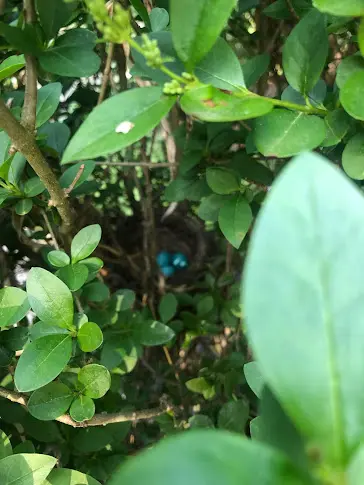
This spring, my planting was delayed due to issues with a wet, rainy, and cold May. At last, this weekend, I planted 9 heirloom tomatoes plants, 3 types of zucchinis, 2 kinds of cucumber, pumpkin, some white Echinacea, and all my herbs. At noon on Sunday, I registered that every time I passed the garden gate, I flushed out a robin from the hedge. This was unusual. The robins don’t usually hang out within the garden itself. I decided to look around. What could be causing a robin to be so protective of the hedge. What do you know? A perfect nest with three brilliant blue eggs was hidden deep inside the hedge, nestled among the leaves. If I hadn’t stop to look, to observe, I would never have known why the robin was here, and why she was acting so defensively.
One of gardening’s great pleasures is the gift it gives with time. They say that every hour you spend on a sailboat adds another year to your life. I think that is true of gardening, as well. You experience time slowing down, and time folding in on itself, as the patterns of the seasons — planting, growth, harvest, death — rise, fall, repeat, and circle back around with each year. Time slows when I am in the garden. I leave my phone inside the house. I am completely off duty from work. My children know they can call my husband if they need me for an emergency, and he knows where to find me. Sometimes, if his schedule allows, he’ll be with me, and we work together, side by side, our knees in the dirt, in our matching straw sun hats.
Being in the garden gives me time to look, time to slow down, time to stop and truly see who shares my home here in Connecticut. I can bathe in the beauty of the natural world: the sounds of birdsong, the feeling of wind and sun on my face. I feel deep gratitude for this special corner that I steward to help create a welcoming landscape and environment. I feel overwhelming joy and awe with each sighting, as if it is the first: the red tail hawk riding the thermals above, the black swallowtail butterfly cruising above the tall grass, the painted box turtle laying her eggs in the gravel path, the bright blue robin’s eggs hidden in the hedgerow. These are the moments that reward observation, silence, and stillness. All qualities I observed in my grandmother in the garden, and that I try to bring into my work each day at Montessori, as the circle of life continues.